




Life is full of situations that challenge our patience, test our emotions, and sometimes push us to our limits. Someone says something hurtful, a friend disappoints us, a colleague disrespects us, or a loved one behaves in a way we never expected. In these moments, we face an important choice: should we react immediately, or should we pause and respond thoughtfully?
Although reacting and responding may sound similar, they represent two very different approaches to life. One is driven by emotions, while the other is guided by awareness, understanding, and self-control.
Learning the difference between reacting and responding can transform our relationships, improve our mental well-being, and help us become emotionally stronger individuals.
1. What Does Reacting Really Mean?
Reacting is an immediate emotional response to something that happens around us. It often occurs without thinking about the consequences of our words or actions.
For example, imagine someone criticizes you in front of other people. Instead of understanding what they are saying, you immediately become angry, raise your voice, and criticize them in return.
Your mind focuses on defending your ego rather than understanding the situation.
This is what emotional reaction looks like.
Reacting is often associated with:
- Anger and frustration.
- Taking things personally.
- Speaking without thinking.
- Blaming others.
- Trying to hurt someone because they hurt you.
- Making decisions based on temporary emotions.
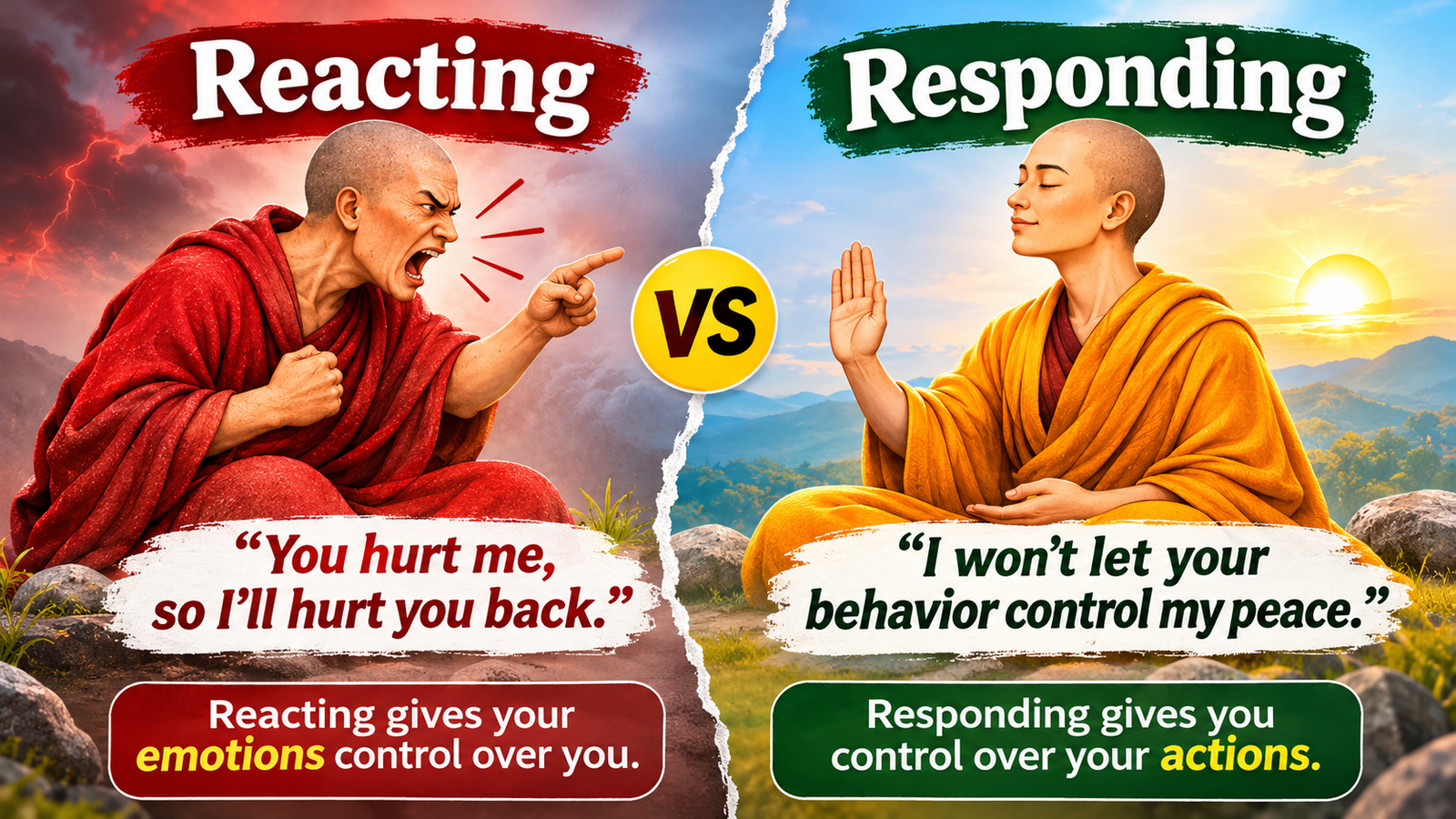
The biggest problem with reacting is that it gives other people too much control over your emotional state.
Someone can say a few unpleasant words, and suddenly your entire day becomes stressful. Someone can behave disrespectfully, and you spend hours thinking about what happened.
In such situations, you are no longer controlling your emotions. Your emotions are controlling you.
2. What Does Responding Mean?
Responding is different. It means taking a moment to understand what is happening before deciding how to act.
Instead of immediately expressing anger, you pause, evaluate the situation, and choose an appropriate response.
Imagine the same situation: someone criticizes you publicly.
This time, instead of shouting back, you remain calm. You listen to what they are saying, consider whether there is any truth in their words, and decide whether the conversation deserves your attention.
You might explain your perspective politely, establish a boundary, or simply walk away.
Responding does not mean accepting disrespect or allowing people to treat you badly.
It means understanding that you have control over your actions, even when you cannot control someone else’s behaviour.
A thoughtful response involves:
- Emotional awareness.
- Patience and self-control.
- Understanding different perspectives.
- Choosing words carefully.
- Setting healthy boundaries.
- Thinking about long-term consequences.
Responding gives you the opportunity to act according to your values rather than your temporary emotions.
3. Why Do We React So Quickly?
Human beings naturally experience emotions such as anger, fear, sadness, jealousy, and disappointment.
When something threatens our sense of security, self-respect, or expectations, our brain may trigger an automatic emotional response.
Sometimes, we react because:
- We feel misunderstood.
- Our ego feels threatened.
- We expect others to behave according to our expectations.
- We have unresolved emotional experiences.
- We struggle to accept criticism.
- We feel that staying silent means losing an argument.
However, not every situation requires an immediate answer.
Sometimes, the strongest thing you can do is give yourself a little time before speaking.
A few seconds of patience can prevent hours, days, or even years of regret.
4. Reacting Gives Others Control Over Your Peace
One of the most important lessons in emotional maturity is understanding that you cannot control how other people behave.
You cannot control someone’s attitude, opinions, words, decisions, or intentions.
But you can control how you choose to deal with them.
If someone insults you and you immediately lose your temper, that person has successfully influenced your emotional state.
If someone ignores you and you spend the entire day feeling worthless, you have allowed their behaviour to determine your happiness.
This does not mean that your feelings are unimportant. Your emotions are real and deserve attention.
However, your peace should not depend entirely on how other people treat you.
You can acknowledge that someone hurt you without allowing that experience to define your entire day.
Remember: Someone else’s behaviour reflects their choices. Your response reflects yours.
5. Responding Does Not Mean Being Weak
There is a common misconception that staying calm means being weak.
Some people believe that if someone disrespects them, they must respond aggressively to prove their strength.
But emotional strength is not measured by how loudly you argue or how quickly you insult someone back.
Sometimes, strength means saying:
“I don’t appreciate the way you’re speaking to me.”
Sometimes, it means refusing to continue an unhealthy conversation.
Sometimes, it means walking away from an argument that has no meaningful outcome.
And sometimes, it means accepting that you made a mistake and apologizing.
Responding calmly does not mean tolerating disrespect, injustice, or manipulation.
You can be kind and still be firm. You can be peaceful and still have boundaries. You can forgive someone and still decide not to keep them in your life.
Real emotional maturity is knowing when to speak, when to listen, when to stand up for yourself, and when to walk away.
6. Practical Ways to Stop Reacting and Start Responding
Changing emotional habits takes time, but a few simple practices can make a significant difference.
Pause Before You Speak
Whenever something makes you angry, avoid responding immediately.
Take a deep breath and give yourself a few seconds to process what happened.
Ask yourself whether your next words will solve the problem or make it worse.
Identify Your Emotions
Instead of simply thinking, “I’m angry,” try to understand what is behind that anger.
Are you feeling disrespected, ignored, disappointed, embarrassed, or misunderstood?
Understanding the actual emotion makes it easier to choose an appropriate response.
Stop Taking Everything Personally
Not every negative comment is an attack on your personality.
People have different perspectives, communication styles, and personal struggles.
Learn to distinguish between constructive criticism and intentional disrespect.
Think About the Consequences
Before saying something hurtful, ask yourself:
“Will I be happy with this response tomorrow?”
A temporary emotional release is rarely worth damaging an important relationship.
Learn to Set Boundaries
Being calm does not mean allowing others to cross your limits.
Communicate clearly when someone’s behaviour is unacceptable.
You do not need to shout to make your boundaries understood.
Accept What You Cannot Control
You cannot force people to understand you, appreciate you, respect you, or agree with you.
Accepting this reality helps you stop wasting emotional energy on things beyond your control.
7. Real-Life Examples of Reacting vs. Responding
Let’s understand the difference through a few everyday situations.
Situation 1: Someone Insults You
- Reacting: “You’re no better than me. Look at yourself first!”
- Responding: “I don’t appreciate that comment. Let’s keep this conversation respectful.”
Situation 2: Someone Ignores Your Message
- Reacting: Sending multiple angry messages and assuming the worst.
- Responding: Giving them time and continuing with your day without making assumptions.
Situation 3: Someone Criticizes Your Work
- Reacting: Becoming defensive and arguing that everything you did was correct.
- Responding: Understanding the feedback and deciding whether it can help you improve.
Situation 4: Someone Breaks Your Trust
- Reacting: Trying to hurt them in return.
- Responding: Acknowledging the pain, communicating your feelings, and deciding whether the relationship deserves another chance.
In every situation, the difference is not about suppressing emotions. It is about choosing actions consciously.
8. Emotional Intelligence Is the Real Strength
Emotional intelligence is the ability to recognize, understand, and manage your own emotions while also understanding the emotions of others.
People with strong emotional intelligence are not people who never become angry, sad, or disappointed.
They experience emotions just like everyone else.
The difference is that they are less likely to let temporary feelings dictate every decision.
They understand that:
- Not every argument deserves their attention.
- Not every opinion needs a response.
- Not every disagreement requires winning.
- Not every person deserves access to their personal life.
- Not every difficult situation is worth sacrificing their peace.
Emotional intelligence helps us build healthier relationships, communicate more effectively, and make better decisions.
It also teaches us an important lesson: You do not have to win every argument to maintain your self-respect.
Conclusion: Choose Your Response, Not Your Reaction
Life will always bring difficult people, unexpected situations, disappointments, and moments that challenge our patience.
You will not always receive the respect you deserve. People will misunderstand you, disagree with you, and sometimes hurt you intentionally or unintentionally.
You cannot eliminate these experiences, but you can change how you deal with them.
Reacting allows temporary emotions to decide your actions. Responding gives you the opportunity to think, understand, and make conscious choices.
The goal is not to become emotionless or pretend that nothing hurts you. The goal is to feel everything without allowing every emotion to control your behaviour.
The next time someone makes you angry, pause for a moment.
Ask yourself:
“Am I going to let this situation control me, or am I going to decide how I respond?”
Because ultimately, reacting gives your emotions control over you, while responding gives you control over your actions.
You cannot control every situation in life, but you can always work on controlling how you respond to it.